Jutta Pfennig
All the Light We Cannot SeeJutta Pfennig is Werner Pfennig’s younger sister, an observant and inventive child whose curiosity survives the constrictions of Nazi rule and the loss of her brother. Her life moves from drawings and improvised radio in the impoverished mining district around Essen to forced labor in wartime Berlin, and finally to a settled adulthood in which the objects Werner leaves behind reopen their shared past. She is not simply the witness to Werner’s story: her own acts of imagination, inquiry, and remembrance carry it forward.
Identity and Childhood
Jutta grows up with Werner and Frau Elena in the mining community around Zollverein. Two years younger than her brother, she is nevertheless the more gifted artist. The siblings lie on their stomachs at Werner’s attic cot and pass a single pencil between them. Jutta draws Paris from just one photograph: its mansard roofs, hazy apartment blocks, and the distant iron lattice of a tower. Her imagined city expands beyond the image into twisting white skyscrapers, complicated bridges, and crowds along a river. The drawings reveal both the limits of what she has seen and the reach of what she can picture.
Their play and exploration are shaped by material scarcity. Werner tows Jutta in a wagon he has assembled from cast-off parts through the mining complex, past pit cottages, trash fires, and laid-off miners. When a wheel comes off, he patiently threads the bolts back in. The children sift black dust, climb over rusting machinery, pick berries and dandelions, and search bins for potato peels, carrot greens, paper, or toothpaste remnants they can dry into chalk. Sometimes Werner takes her as far as Pit Nine, where the enormous coal elevator, swinging cables, and shouting workers make the industrial world around them physically present. This childhood is not insulated from hardship; its resourcefulness is a way of living inside it.
Curiosity, Radio, and Resistance
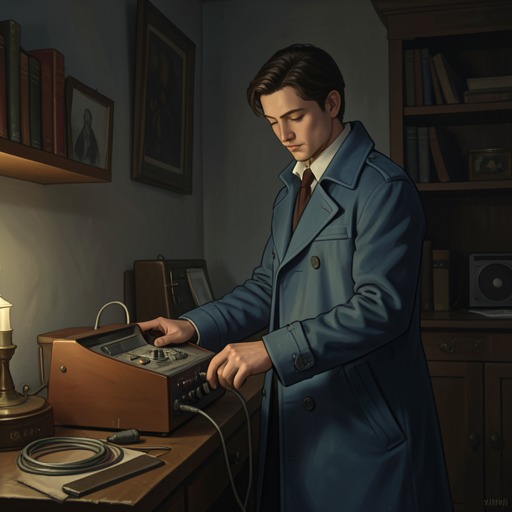
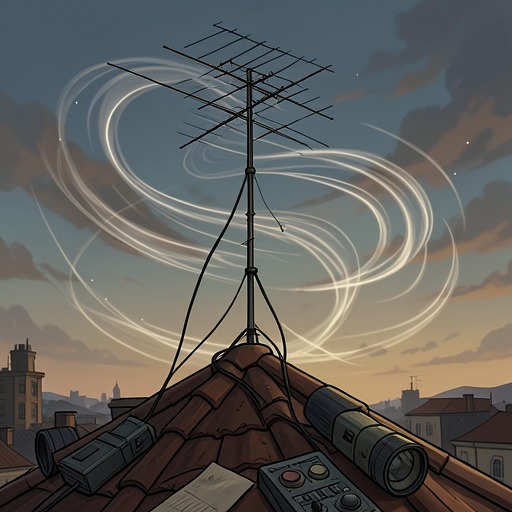
Jutta’s curiosity becomes a shared undertaking when she finds ten yards of copper wire amid rusted drums, shredded inner tubes, and creek-bottom muck. She asks Werner to swear secrecy; he does, and together they smuggle the wire home, thread it through nail holes in the eaves outside the attic window, and connect it to their radio. A shortwave broadcast soon comes through in a language they do not recognize. The scene echoes her earlier drawings: with scarce materials and limited knowledge, Jutta reaches beyond the world immediately around her.
She also writes to the Professor, uncertain whether her letters are received or whether the broadcast has stopped. In one letter she reports that she and Werner have heard nothing for at least two months. She describes Deutschlandsender 3, a transmitter in Brandenburg that, according to her brother, is more than three hundred thirty meters tall and crowds other signals off the dial. Werner has explained that a wire fence can serve as an antenna, and Jutta delights in the possibility that silver fillings might receive signals too. Her speculation about songs in people’s teeth turns technical information into wonder, while her letter itself becomes an effort to keep a distant connection alive.
That effort carries real danger. Frau Elena now requires the children to come straight home from school, and Jutta knows that tuning in to a foreign broadcast is a criminal offense punishable by hard labor. She writes that she and Werner are poor, though not Jewish, and that poverty too feels dangerous. With no one willing to help mail her letter, she decides to do it herself. Her closing salutation joins ordinary politeness to the regime’s demanded greeting, exposing the pressure under which even a private message must be composed.
Later, Jutta confronts Werner about the radio he has ruined. She recalls that it carried broadcasts from Paris, which contradicted the German broadcasts and reported German atrocities. Her question about what those atrocities mean makes clear that she is trying to understand not only competing claims but the moral reality they describe. The radio is at once an object of discovery, a source of forbidden information, and a point of conflict between brother and sister. Jutta’s awareness persists even when access to the broadcasts does not.
Forced Labor and Werner’s Death
In January 1945, fifteen-year-old Jutta is transported from Essen to Berlin with Frau Elena and the last four girls living at Children’s House. They are assigned to a machine-parts factory, where for ten hours a day, six days a week, they dismantle massive forging presses and stack reusable metal in crates for shipment by train. Frau Elena works nearby in a torn ski jacket, sometimes murmuring in French or singing songs from childhood. The girls live above an abandoned printing company among hundreds of crates of misprinted dictionaries, which they burn page by page in a potbelly stove. Words printed in abundance become fuel; the contrast sharpens the deprivation of their daily life.
The factory eventually runs out of materials. Rumors circulate that no one is in charge and that the collected copper, zinc, and stainless steel are being left on railway sidings. When the factory is padlocked in late March, Jutta and the others are sent to clear bomb damage, lifting masonry and sifting dust and shattered glass. She hears of teenage boys who return home frightened and are dragged from their mothers’ attics as deserters, then shot in the street. In this ruined landscape, memories of childhood with Werner—riding in the wagon and searching through refuse—return to her as she looks for something salvageable.
The name she whispers is Werner’s. In the fall, at Zollverein, she had received two letters announcing his death, but they gave different burial places: La Fresnais and Cherbourg, towns in France she had to look up. The conflicting locations leave the news without a single firm resting place. In dreams she stands with Werner over a table strewn with gears, belts, and motors while he says he is making something, working on it, and then does not continue. Her remembered brother remains associated with invention, but the dream stops before the work can be completed. Loss is presented not as a resolved account but as an interruption that keeps recurring.
Later Life and the Objects of Memory
As an adult, Jutta Wette teaches sixth-form algebra in Essen, teaching integers, probability, and parabolas. She wears black slacks and a nylon blouse, varying its color, and her hair remains white as paper. Her husband, Albert, is a kind, slow-moving accountant who loves running model trains in their basement. After Jutta had long believed she could not become pregnant, she has a son at thirty-seven. Max, six years old in the scene, is absorbed in folding paper airplanes, testing different wings, tails, and noses. His concentrated transformation of flat paper into something that can fly quietly recalls the inventive attention that marked Jutta and Werner’s childhood, without making Max a replacement for her brother.
A duffel bag brings that earlier life into the present. When Jutta opens it, she finds a thick envelope and a newspaper-wrapped wooden model house, narrow and no bigger than her fist. The envelope contains the question notebook she had sent Werner forty years earlier: tiny sloping handwriting, drawings, schematics, and lists. Among its contents is a design for something like a blender powered by bicycle pedals. The notebook preserves their old exchange of curiosity in Werner’s handwriting, while the model house adds an object whose origin Jutta does not yet know.
Jutta takes the house to a museum in Paris and tells the bearded man at the counter, in French, that her brother had it and that she believes he found it there during the war. The man first shakes his head, then asks to see the model again. Under a lamp, he turns it until its recessed front door faces him, recognizes it, and leads Jutta and Max through a dozen turns in the narrow, sloping streets to the real building it reproduces. The miniature thus becomes more than a keepsake: it provides a route from Werner’s wartime past to a place Jutta can locate for herself. Across her life, she keeps making connections from fragments—a signal through wire, a city from a photograph, a brother’s history from letters and objects—and the model house gives that practice a final, tangible destination.